What is Telecardiology? A Complete Guide (2026)
Heart disease claims more than a million lives every year, and many of these deaths are preventable with earlier diagnosis and consistent care. Telecardiology addresses exactly this gap; it brings expert cardiac care to patients no matter where they live.
Telecardiology services are a form of telemedicine. Think of it as a cardiologist seeing patients remotely using a web-based platform or a mobile app. These telemedicine platforms for providers offer features that make care accessible and cost-effective as well.
But first, let’s understand what a telemedicine platform can do!
A telemedicine platform for providers is like a virtual clinic. It offers providers and their staff the following capabilities:
- Easy appointment scheduling and patient record access.
- Secure video consultations for real-time assessments.
- Document sharing and messaging for smooth follow-up care.
- Features like e-prescriptions and EHR integration for efficiency.
Where does Telecardiology fit in all this?
Patients with chest pain, high blood pressure, or arrhythmias need regular check-ups with specialists. Telecardiology makes these check-ups easier and more affordable:
- Heart patients can get expert care from the comfort of their homes.
- They can stay on top of their health with regular video consultations.
- They can skip non-emergency in-person visits, saving time and money.
Now that we have some understanding of telecardiology and its benefits, let’s discuss it in detail.
Table of Contents
- What is Telecardiology?
- How Have Telecardiology Services Transformed the Healthcare Landscape?
- How Does Telecardiology Work?
- Why Use Telecardiology for ECG Tests & Remote Monitoring?
- How is Telecardiology Empowering Pediatric and Primary Care?
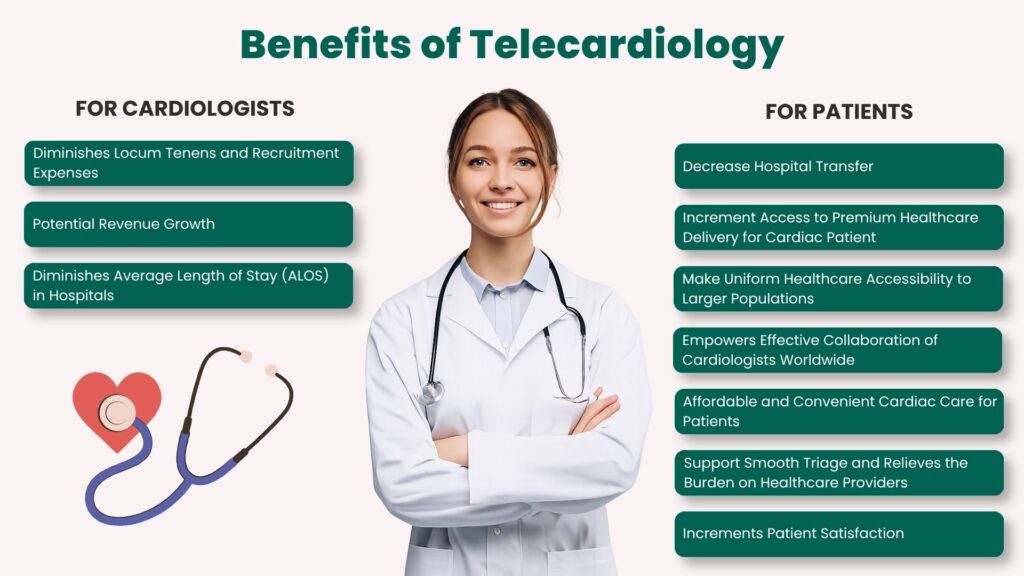
- Benefits of Telecardiology
-
For Patients
- 1. Decreases Hospital Transfers
- 2. Increment Access to Premium Healthcare Delivery for Cardiac Patients
- 3. Make Uniform Health Care Accessibility to Larger Populations
- 4. Empowers Effective Collaboration of Cardiologists Worldwide
- 5. Affordable and Convenient Cardiac Care for Patients
- 6. Support Smooth Triage and Relieve the Burden on Healthcare Providers
- 7. Increase Patient Satisfaction
- For Cardiologists
-
For Patients
- Conclusion
- FAQs
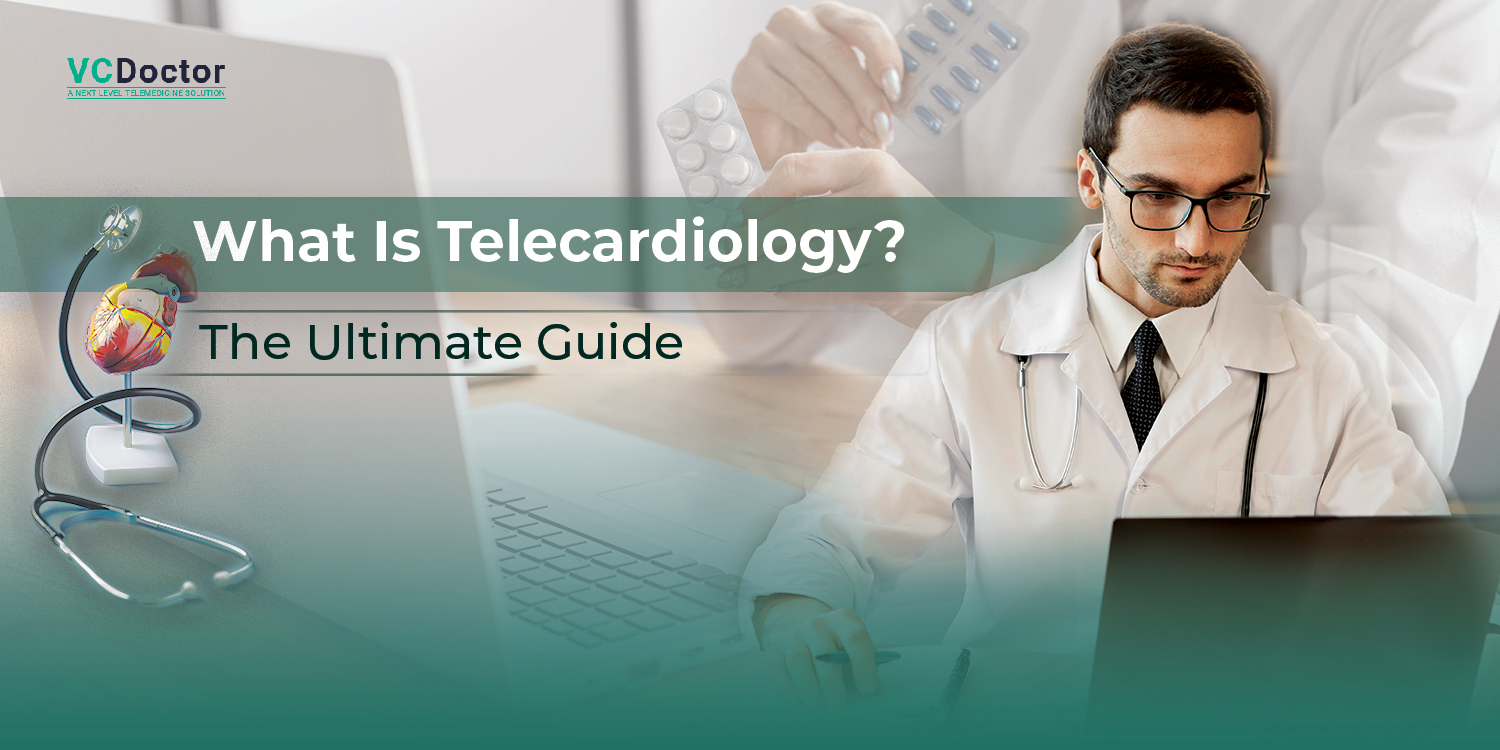
What is Telecardiology?
Telecardiology refers to the remote monitoring of patients who use implantable cardiac devices, such as pacemakers, defibrillators, or Holter monitors.
This model connects patients with healthcare providers anywhere in the world, regardless of location. Most hospital telecardiology teams have a dedicated support staff that helps manage these patients internationally.
Telecardiology is used to diagnose cardiovascular conditions such as myocardial infarction, congenital heart disease, and coronary artery disease, and it also supports affordable treatment for these conditions, all delivered remotely through video consultations.
How Have Telecardiology Services Transformed the Healthcare Landscape?
Cardiovascular disease remains one of the leading causes of death worldwide, and nearly 1 in 5 heart attacks occur without the patient even realizing it is happening. In Europe alone, cardiovascular disease accounts for nearly half of all deaths. These numbers highlight why heart health needs to be treated as an urgent priority.
The COVID-19 pandemic accelerated the shift toward virtual care, as hospitals prioritized capacity for infectious disease patients and cardiac patients needed a safe, effective alternative to in-person visits. This period made clear how essential a scalable, remote care model is for heart health.
Telehealth software recovery takes special care of the requirements of patients all over the place, even in remote and inaccessible regions. Furthermore, it offers medical services to labourers as a fundamental breather and permits them to work at their own pace. The telecardiology facility for medical care is empirical; it has served various patients throughout the pandemic, and medical services and suppliers continually correct past blunders and missteps to change this into a robust framework.
Generally, telecardiology can assist with saving time, cash, and energy for geriatric patients. It is the rising face of present-day medical services.
How Does Telecardiology Work?
The technology behind telecardiology is straightforward. After a 12-lead ECG test at your local clinic, the reading is transmitted electronically to a remote telecardiology center.
A cardiologist then reviews the results and sends back a diagnosis, typically through a secure platform, email, or a follow-up video call. In most cases, this entire process is completed before you even leave the clinic.
Telecardiology equipment tackles holes in medical services. Not having a cardiologist at your nearby emergency clinic no longer means hanging tight days for results. Depending on an overall specialist who might not have the experience to analyze you without error isn’t an issue.
Want to Bring Telecardiology to Your Hospital or Clinic?
Enable secure remote cardiac consultations and patient monitoring with VCDoctor’s telemedicine platform. Connect with our team to explore the right solution for your practice.
Talk to Our ExpertsWhy Use Telecardiology for ECG Tests & Remote Monitoring?
In current clinical practice, media communications can send a wide range of clinical trials and information in a moment. One sort is ECG tests. It’s not unexpected to have a cardiologist from an alternate area see test results and send a determination.
There are different justifications for why. When a facility doesn’t have a cardiologist on staff, they can send the test picture over to another facility that does. This is normal in areas with scanty populations. They send their tests over to bigger metropolitan clinics for understanding.
Another situation where telecardiology may become the most important factor is when an expert needs to check a test out. Different explanations behind its utilization include:
- Hearing apprehensions about troublesome findings or inner serenity
- Covering evening hours when no cardiologist is on staff
- Staff sharing circumstances
- Instructing and preparing
- Covering cardiologists who are on an extended getaway
Read Also: Remote Patient Monitoring Market Growth, Trends and Statistics
How is Telecardiology Empowering Pediatric and Primary Care?
Essential consideration centres around the anticipation, advancement, and restoration of diseases. With telecardiology, essential and pediatric consideration has fundamentally moved along.
Here’s an example that illustrates this. An echocardiogram is a test that uses ultrasound waves to examine the heart, helping specialists assess its rhythm and function. The Echocardiogram can likewise be utilized to analyze Arrhythmias and other heart diseases.
An echocardiogram is of most extreme significance in pediatric medical services, particularly its role in diagnosing and treating heart illnesses in youngsters before they progress.
Telecardiology underlines the requirement for these reverberation tests. Hence, they are currently being presented on a lot more extensive scale. These echocardiograms can be electronically sent to an expert on the planet to guarantee exact and fast recognition of heart diseases. Telecardiology is making these lab examinations savvy and helpful, uplifting more areas to provide such testing services at the essential degree of healthcare.
Benefits of Telecardiology
Telecardiology overcomes any issues among essential and optional considerations. Depending on the utilization of innovation is the main reasonable way to handle natural issues while fulfilling patients’ requirements. There are various advantages of telecardiology, making sense of why numerous healthcare frameworks are quickly leaning towards it.
For Patients
1. Decreases Hospital Transfers
Only one out of every odd locale or town has a tertiary emergency clinic to address complicated medical services concerns. This expands the number of emergency clinic moves, particularly for individuals experiencing serious heart diseases. Patients need to take care of their transportation expenses for a far-off tertiary emergency clinic on top of the treatment they get.
With telecardiology, it can take just one arrangement to decide if the patient can be overseen basically, hence constricting the issue of emergency department moves.
2. Increment Access to Premium Healthcare Delivery for Cardiac Patients
Patients living in rural or far-off regions normally depend on general practitioners for their heart health since cardiologists might be scarce in such regions. With telecardiology, they can get access to the expertise of cardiologists who have served for a very long time in the field.
Local area clinics can become intensely overwhelmed with patients, burdening patients by compelling them to invest impressive measures of energy standing by. With heart sicknesses, a brief conclusion and time are of the essence. Telecardiology can diminish standby times and assist with giving quicker counsel.
This study inferred that telecardiology models convey comparable outcomes for patients experiencing cardiovascular breakdown as face-to-face arrangements.
3. Make Uniform Health Care Accessibility to Larger Populations
It is every resident’s right to get standard and quality medical care. Because of telecardiology, patients can associate with their cardiologists no matter what their area. This is a fundamental part of giving quality medical services to all residents, no matter what their conditions, particularly the individuals who are confined to provincial networks and remote areas.
4. Empowers Effective Collaboration of Cardiologists Worldwide
Patients experiencing heart infections offset the number of accessible cardiologists. With most cardiologists serving a greater part of their working hours in the activity theatre, they frequently have a brief period to impart their skill and insights for a powerful, coordinated effort worldwide.
Through video conferencing, cardiologists worldwide can offer their clinical counsel of real value without being truly present in the working room. This further prepares doctors and medical services experts to settle on informed conclusions about heart conditions in a virtual setting.
Cardiologists can likewise utilize telecardiology equipment to progressively examine and show their clinical cases. The force of innovation joins cardiologists to hold hands and foster inventive arrangements and medicines for heart illnesses.
5. Affordable and Convenient Cardiac Care for Patients
Heart Disease medicines and meds are expensive, and the cost of everyday driving expenses can add to the cost. Specialists request that patients put away cash, yet significant investment.
Numerous heart illnesses take a constant course, from Atherosclerosis to hypertension. They request regular meetings with a cardiologist, which can pressure the patient who is now battling the infection.
Telecardiology wipes out movement expenses and saves energy, scaling down medical care costs and upscaling comfort levels for the patient.
6. Support Smooth Triage and Relieve the Burden on Healthcare Providers
With fewer patients making medical clinic visits and more depending on the telecardiology model, medical care providers feel quite overwhelmed dealing with their patients.
Research has consistently found that hospitals with a higher cardiologist-to-cardiac-bed ratio see lower 30-day mortality rates for heart failure patients. This reinforces the requirement for a framework that would permit more specialists to zero in on crisis patients without becoming overburdened.
When the emergency clinic becomes overwhelmed with patients, telecardiology will diminish the imbalanced specialist-to-patient proportion that frequently brings chaos and ruin inside the clinic premises. That, as well as the responsibility, results in a significant and well-regarded medical services force.
7. Increase Patient Satisfaction
There’s a ton that Telecardiology brings to the table regarding patient fulfilment. Patients can make arrangements without undermining their plans for getting work done. Moreover, the decreased standby times with telehealth are one of the benefits of telehealth for the patients.
Through review studies, telehealth software has flaunted high persistent fulfilment rates. In this review, 47.4% of patients were happy with telehealth services. These patients additionally developed great compatibility and were entrusted with their assigned medical service providers.
Read Also: Telehealth Software: Key Features, Benefits & Challenges
For Cardiologists
1. Diminishes Locum Tenens and Recruitment Expenses
Locum tenens is the term used to portray doctors who briefly satisfy the obligation of another. The target of locum tenens is to lessen the responsibility and stress loads on the extremely durable doctor staff that goes through lengthy, depleting hours providing medical services.
Telecardiology sidesteps the requirement for locum tenens, as this model is intended to ease specialists by decreasing the patient flow to the emergency departments. In this manner, it takes special care of fewer enrollments and adds to additional time and cost reserve funds.
2. Potential Revenue Growth
The age of beneficial income is basic for any industry to get by, and telecommunication through telemedicine is drawing in additional financial backers because of its promising capital age.
Telecardiology models depend on practical innovation, including telehealth software and video conferencing equipment. These instruments generally call for one-time speculation and incidental rounds of support.
Patients who battle persistent heart infections require successive arrangements and nonstop checking. These patients are alluded to as retentive, implying that they become their primary income generators.
3. Diminishes Average Length of Stay (ALOS) in Hospitals
An ALOS is the typical number of days a patient spends in the medical clinic. With the utilization of telecardiology, the ALOS at an emergency clinic is supposed to diminish as patients resort to virtual consideration after their most memorable actual arrangement. This lessens the clinic’s weight while reinforcing its telecardiology framework’s income.
Ready to Launch Telecardiology Services?
Empower your cardiologists with secure video consultations, remote patient monitoring, and seamless clinical workflows, all on a single platform. Schedule a free demo to see how VCDoctor can help you get started.
Contact Us TodayConclusion
To sum up, telecardiology services are all set to transform the lives of heart patients for the better. And not just patients, even cardiologists can benefit significantly from this amazing tool.
Do you want to offer telecardiology services to your patients, too?
If yes, then VCDoctor is the ideal telemedicine platform for cardiologists. It comes packed with features that will help you manage your workflows like a pro and also grow your practice.
Plus, the VCDoctor telemedicine platform for clinics is white-label and HIPAA-compliant. You can brand it as you wish and rest assured that all healthcare data on the platform is secure and well-protected.
You can book a free VCDoctor demo too! Simply visit our Contact Us page, share your details, and send them to us. Next, our team will offer a demo on your preferred day and time.
FAQs
Yes, you can manage your entire clinic and care team from the VCDoctor telemedicine platform. Once you log on, you will be greeted with an intuitive dashboard. On the dashboard, you will have options to manage clinic locations, the care team, and the patient records as well.
Yes, we ensure region-wise compliance needs. We use the latest data standards, encryption methods, and interoperability features to ensure respective compliances are met. While HIPAA compliance is met by default, we can further customise the platform to meet NABIDH, ABDM, and GDPR compliance norms.
We can integrate AI chatbots, Queue management systems, and lots of other features. These are integrated only on client requests. You can learn about all the advanced features in detail on our home page.
Yes, the VCDoctor telemedicine platform is fully white-label and customizable. We can customize it to align with your brand identity. Plus, we can edit, add or delete features to meet your specific needs.
We support the most secure and advanced payment gateways, including SWIPE, RAZORPay, and others. We also have a payment log feature where patients and providers can view and manage payments.
Coverage varies by provider and plan, but most major insurers now reimburse telecardiology consultations similarly to in-person cardiology visits, especially since telehealth coverage expanded after 2020. Patients should confirm coverage details with their specific insurance provider before booking.